
 By As Law Online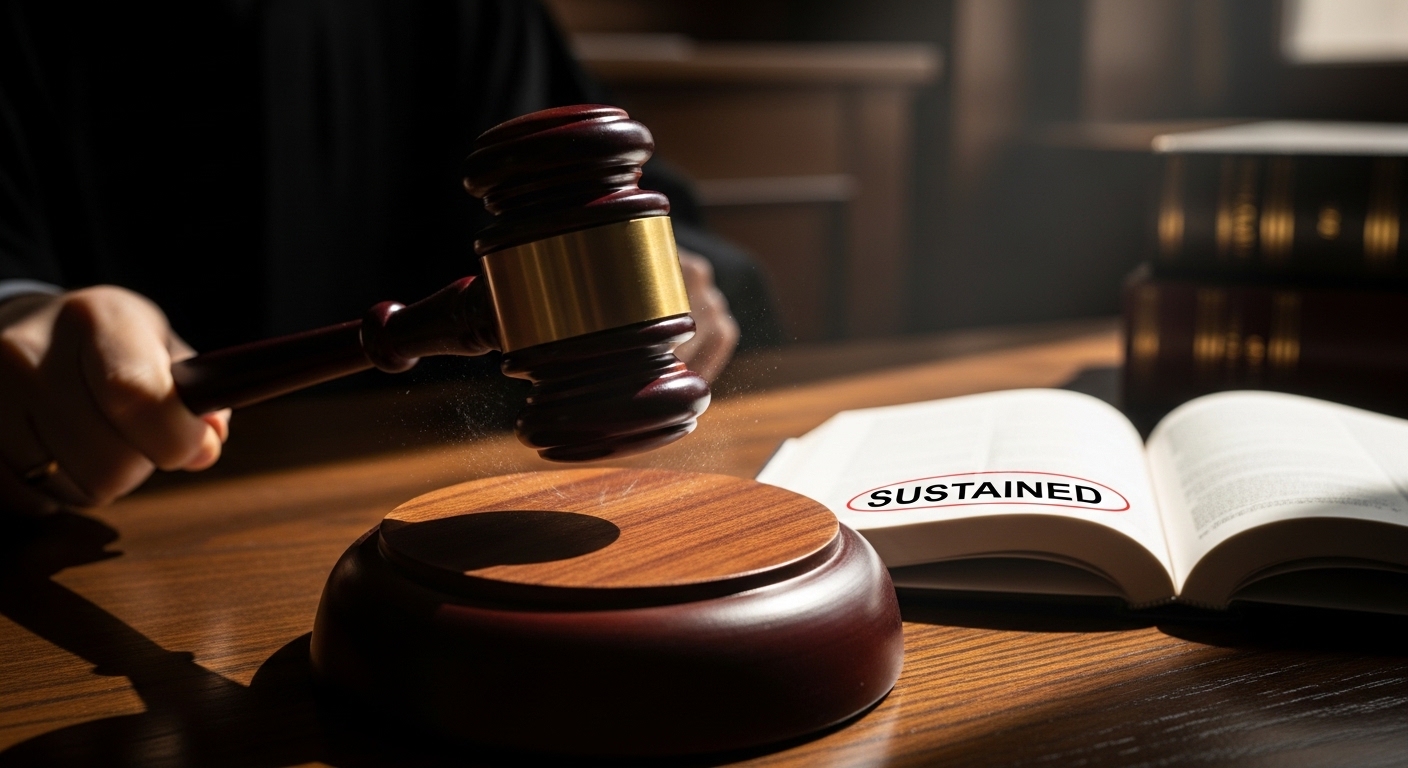
- In courtroom proceedings, “sustained” refers to a judge’s ruling that agrees with an attorney’s objection, typically preventing certain testimony or evidence from being presented. This helps ensure trials adhere to evidentiary rules and fairness.
- It is a standard term used across U.S. jurisdictions, with no major variations in meaning, though application depends on context like trial type.
- While straightforward, its use underscores the importance of procedural rules in maintaining judicial integrity, as supported by legal experts and court glossaries.
Understanding the Term
When an attorney objects to a question, piece of evidence, or statement during a trial—often citing reasons like irrelevance, hearsay, or leading the witness—the judge must decide whether to allow it. If the judge says “objection sustained,” it means they concur with the objection, and the matter in question is disallowed. This ruling protects the integrity of the proceedings by excluding potentially improper or prejudicial information. For instance, in everyday court practice, this prevents juries from hearing inadmissible details that could bias their decision-making.
Common Contexts
“Sustained” is most frequently heard in trial settings, such as during witness examinations in civil or criminal cases. It applies in both federal and state courts, aligning with rules like the Federal Rules of Evidence. Judges may instruct the jury to disregard any related testimony already given, emphasizing the term’s role in upholding fair trials.
Implications for Participants
For those involved in legal disputes, understanding “sustained” highlights why skilled legal representation matters—it can influence what evidence reaches the fact-finders. If you’re in court, note that such rulings are final in the moment but can be appealed later if they impact the case outcome.
Disclaimer: This article is for informational purposes only and does not constitute legal advice. Readers should consult a qualified attorney for advice specific to their situation.
Introduction
In the realm of courtroom proceedings, the term “sustained” often emerges during heated exchanges between attorneys and judges, particularly in response to objections. But what does sustained mean in court? At its core, it signifies a judge’s agreement with an objection raised by one party, effectively barring certain questions, testimony, or evidence from being considered. This ruling plays a crucial role in maintaining the fairness and integrity of trials, ensuring that only admissible information influences the outcome.
This concept matters now more than ever as public interest in high-profile trials—such as those involving consumer rights, corporate disputes, or criminal justice—continues to grow, amplified by media coverage and streaming services. Individuals affected by lawsuits, whether as defendants, plaintiffs, witnesses, or jurors, may encounter this term in real-life scenarios, from personal injury cases to regulatory enforcement actions. Professionals in compliance roles, such as corporate counsel or regulatory analysts, also monitor such procedural nuances to anticipate how they might impact broader legal strategies.
By demystifying “sustained,” this article aims to provide clarity for non-lawyers while offering insights into how these rulings shape legal disputes and consumer protections.
Background & Legal Context
The use of “sustained” in court traces back to foundational principles of U.S. jurisprudence, rooted in the adversarial system where opposing parties present evidence under strict rules. Historically, courtroom objections and rulings evolved from English common law traditions, formalized in the U.S. through documents like the Federal Rules of Evidence (FRE), adopted in 1975 by the U.S. Supreme Court and Congress. These rules, along with state equivalents like those in California or New York courts, govern what can be admitted in trials to prevent undue prejudice or confusion.
Prior rulings and policies from institutions such as the U.S. Supreme Court have reinforced the importance of such procedural safeguards. For example, in landmark cases involving evidentiary disputes, the Court has emphasized that judges act as gatekeepers to ensure trials remain focused on relevant facts. Legislative intent behind these frameworks, as seen in congressional debates on evidence rules, prioritizes efficiency and justice, preventing trials from devolving into unchecked arguments.
In practice, “sustained” appears in various court documents, from trial transcripts to appellate opinions. State bar associations, like the American Bar Association (ABA), provide guidelines on objection practices, underscoring that these rulings are essential for upholding due process under the Fifth and Fourteenth Amendments.
Key Legal Issues Explained
To fully grasp what does sustained mean in court, it’s essential to break down the related concepts in plain English while referencing precise legal standards.
An objection is a formal protest by an attorney against a question, statement, or piece of evidence presented by the opposing side. Common grounds include irrelevance (FRE Rule 402), hearsay (FRE Rule 802), or leading questions (FRE Rule 611). When an objection is raised, the judge must rule promptly to keep the trial moving.
If the judge says “sustained,” they are upholding the objection, meaning the challenged element is improper and cannot proceed. This could result in the witness not answering a question, evidence being excluded, or testimony being stricken from the record. In contrast, “overruled” means the judge disagrees, allowing the matter to continue.
Rights and responsibilities here tie into broader legal principles: Attorneys have a duty to object timely to preserve issues for appeal (as per appellate rules in circuits like the Ninth Circuit Court of Appeals), while judges must apply evidence rules neutrally. Implications include potential mistrials if improper rulings accumulate, affecting parties’ rights to a fair hearing.
For real-world context, consider a personal injury lawsuit where a plaintiff’s attorney objects to a defense question implying fault without basis—the judge sustaining it prevents misleading the jury.
| Term | Definition | Common Use in Court | Implications |
|---|---|---|---|
| Sustained | Judge agrees with objection; item is disallowed. | During witness testimony or evidence admission. | Protects trial fairness; may lead to rephrasing or exclusion. |
| Overruled | Judge disagrees; item proceeds. | Same as above. | Allows evidence; can be appealed if erroneous. |
| Objection | Formal challenge to procedure or evidence. | Raised by attorneys. | Preserves record for review; ensures compliance with rules. |
| Stricken | Testimony removed from record. | After sustained objection. | Jury instructed to disregard; prevents prejudice. |
This table illustrates how “sustained” fits into objection dynamics, drawing from standard courtroom procedures.
Latest Developments or Case Status
As of February 2026, the core meaning of “sustained” remains unchanged, with no major legislative overhauls to evidence rules since the last FRE amendments in 2011. However, recent announcements from the Judicial Conference of the United States highlight ongoing efforts to modernize court procedures, including virtual hearings where objections are handled digitally.
In notable recent filings, such as in ongoing antitrust lawsuits against tech giants (e.g., U.S. v. Google, ongoing in federal courts), judges have frequently sustained objections to protect proprietary information, reflecting the term’s application in contemporary disputes. Regulatory agencies like the Federal Trade Commission (FTC) also reference similar rulings in administrative hearings, where “sustained” ensures compliance with due process.
No specific “case status” applies universally to this term, as it’s procedural rather than tied to a single lawsuit. However, appellate courts continue to review sustained objections for abuse of discretion, as seen in 2025 decisions from the U.S. Supreme Court on evidentiary standards.
Who Is Affected & Potential Impact
Consumers involved in class-action lawsuits, such as those over defective products or data breaches, may see “sustained” rulings exclude damaging corporate evidence, potentially strengthening their claims. Businesses, particularly in regulated industries like finance or healthcare, face risks if objections to their defenses are sustained, leading to higher liability.
Institutions like state supreme courts or federal districts are affected through workload—frequent objections can prolong trials, impacting judicial efficiency. Possible outcomes include settlements if key evidence is barred, or appeals if rulings are deemed erroneous, with consequences ranging from monetary damages to policy changes.
For example, in employment discrimination cases under Title VII, sustaining objections to biased questioning can empower affected employees, highlighting the term’s role in protecting vulnerable parties.
What This Means Going Forward
The legal significance of “sustained” reinforces the judiciary’s commitment to evidence-based justice, influencing how cases are prepared and argued. For industries, it signals the need for robust compliance programs to avoid objectionable practices during litigation.
Public impact includes greater transparency in trials, as these rulings are part of public records, allowing oversight by watchdogs like the ABA. Readers should monitor updates from sources like the U.S. Courts website for any rule changes, especially with potential AI-assisted evidence reviews on the horizon.
In expert analysis, while no predictions are certain, sustained objections could become more scrutinized in appeals amid rising case volumes, urging attorneys to refine their strategies.
Conclusion
In summary, understanding what does sustained mean in court reveals a key mechanism for ensuring fair and orderly trials, where judges safeguard against improper influences. This procedural tool underscores the balance of power in the justice system, protecting rights while promoting efficiency.
Its public relevance lies in empowering informed participation in legal matters, whether as a litigant or observer. Staying informed through reputable sources like state bar associations or federal court resources is advisable, as procedural nuances continue to evolve with societal changes.
Frequently Asked Questions
What does sustained mean in court when an objection is raised?
Sustained means the judge agrees with the objection, disallowing the question or evidence to proceed, based on rules like the FRE.
What is the difference between sustained and overruled in court?
Sustained upholds the objection, while overruled rejects it, allowing the challenged item to continue.
Can a sustained objection be appealed?
Yes, if it materially affects the case, it can be reviewed on appeal for abuse of discretion by higher courts like circuit appeals.
Why do judges sustain objections?
To enforce evidentiary rules, preventing irrelevant, prejudicial, or improper information from influencing the jury or judge.
What happens after a judge says sustained?
The attorney may rephrase the question, move on, or the court may strike testimony; in some cases, a sidebar discussion follows.
Is “sustained” used only in criminal courts?
No, it’s used in both criminal and civil proceedings, as well as administrative hearings by agencies like the FTC.
You May Also Like: Justin Billingsley Greene Law: A Complete Guide to Their Legal Services