
 By As Law Online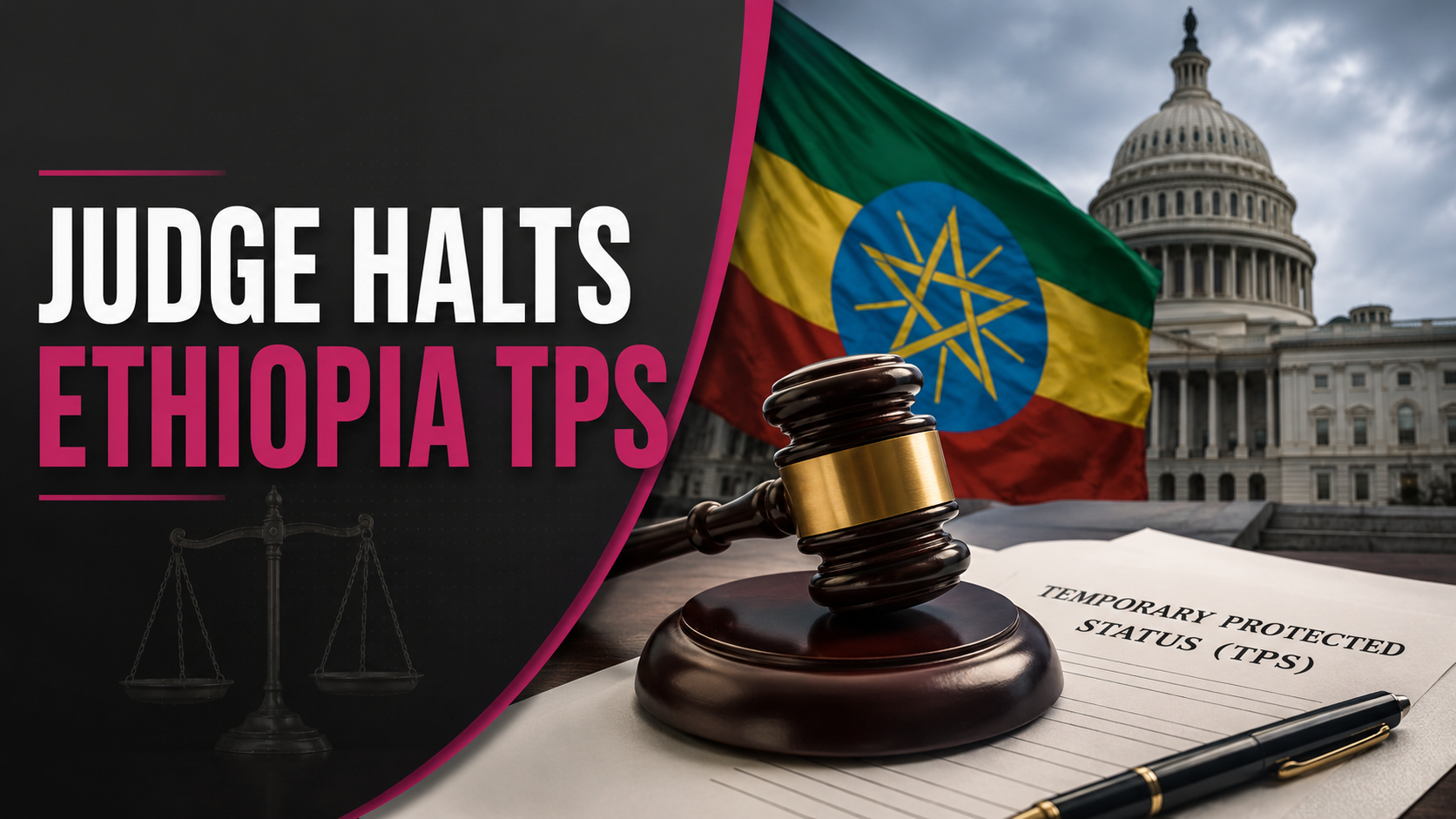
A federal judge in Massachusetts has postponed the Trump administration’s planned termination of Temporary Protected Status (TPS) for Ethiopian nationals living in the United States. The ruling keeps roughly 5,000 individuals protected from deportation and authorized to work while litigation continues. The decision centers on whether the Department of Homeland Security (DHS) followed the statutory process Congress established for reviewing and ending TPS designations.
This development matters because TPS provides temporary humanitarian relief to people from countries experiencing armed conflict, natural disasters, or other extraordinary conditions that make safe return difficult. For Ethiopian TPS holders, the pause means continued legal status and employment authorization under court order. Broader implications reach other TPS programs and the limits of judicial review over immigration designations after a related Supreme Court decision.
This article is for informational purposes only and does not constitute legal advice. Individuals affected by TPS changes should consult a qualified immigration attorney for guidance specific to their circumstances.
Background & Legal Context
Temporary Protected Status is a form of humanitarian relief created by Congress in the Immigration Act of 1990 and codified at 8 U.S.C. § 1254a. The Secretary of Homeland Security may designate a foreign country for TPS when conditions there prevent nationals from returning safely. Qualifying conditions include ongoing armed conflict, environmental disasters, or other extraordinary and temporary situations. Once designated, eligible nationals already present in the United States may apply for TPS. Beneficiaries receive protection from removal and work authorization for the designation period, typically 6 to 18 months, with possible extensions.
Ethiopia received its initial TPS designation in December 2022 under the Biden administration. Officials cited escalating armed conflict, particularly in the Tigray region, along with related humanitarian crises including internal displacement, food insecurity, and disease outbreaks. The designation was later extended. DHS published a Federal Register notice on December 15, 2025, announcing termination of Ethiopia’s TPS designation, effective February 13, 2026. Then-Secretary Kristi Noem stated that Ethiopia no longer met the statutory conditions, pointing to improved security and other factors. The notice provided the minimum 60-day notice period required by statute.
Plaintiffs, including the organization African Communities Together and individual Ethiopian TPS holders, filed suit in the U.S. District Court for the District of Massachusetts. The case is African Communities Together et al. v. Noem et al., No. 26-cv-10278-BEM. They challenged the termination under the TPS statute, the Administrative Procedure Act (APA), and equal protection principles. On January 30, 2026, U.S. District Judge Brian E. Murphy issued an administrative stay delaying the February 13 effective date to allow time for further proceedings. On April 8, 2026, Judge Murphy granted the plaintiffs’ motion to postpone the effective date of the termination pending resolution of the merits.
Judge Murphy, appointed by President Biden, found that DHS terminated the designation “without regard for the process delineated by Congress.” He emphasized that presidential directives do not override statutory obligations. In the memorandum and order, he wrote that fundamental to the case and the constitutional system is the principle that the will of the President does not supersede that of Congress. Presidential whims, he stated, do not and cannot supplant agencies’ statutory obligations. The court concluded plaintiffs were likely to succeed on claims that the agency failed to follow required consultation and review procedures.
The TPS statute requires the Secretary to consult with appropriate government agencies when making designation, extension, or termination decisions and to base those decisions on country conditions. Plaintiffs argued the process was preordained by administration policy rather than a meaningful review of conditions in Ethiopia, where armed conflict and humanitarian challenges reportedly persisted. The government maintained that conditions had improved sufficiently and that the decision fell within the Secretary’s authority.
Related litigation involving other countries has shaped the legal landscape. In June 2026, the Supreme Court decided Mullin v. Doe (consolidated with Trump v. Miot), 609 U.S. ___ (2026). In a 6-3 decision authored primarily by Justice Samuel Alito, the Court held that the TPS statute’s judicial-review bar at 8 U.S.C. § 1254a(b)(5)(A) precludes review of non-constitutional claims challenging designations or terminations. The provision states there is no judicial review of any determination of the Secretary with respect to the designation, termination, or extension of a designation of a foreign state. The Court also found that equal-protection claims challenging the Haiti termination on racial-animus grounds were unlikely to succeed, citing a race-neutral explanation rooted in the administration’s broader opposition to the TPS program as previously implemented. The ruling cleared the way for termination of TPS for Haiti and Syria. Lower courts handling other country challenges, including Ethiopia, have been required to align with this precedent.
As of August 2026, the Ethiopia case remains active. USCIS guidance has repeatedly extended the validity of certain Employment Authorization Documents (EADs) issued under Ethiopia TPS “per court order,” with placeholder dates updated periodically (most recently referencing dates in mid-to-late August 2026). Beneficiaries retain status and work authorization while the stay or postponement remains in effect, subject to further court orders. Hearings and briefing on motions to dismiss, lift stays, and related issues have continued.
Key Legal Issues Explained
Several core legal concepts frame the dispute.
First is the scope of the Secretary’s authority under the TPS statute. Congress granted the Secretary discretion to designate, extend, or terminate based on specified conditions. The statute also imposes procedural requirements, including consultation with other agencies and consideration of country conditions. Courts have examined whether agencies may treat those requirements as formalities when policy priorities shift.
Second is the Administrative Procedure Act. Under the APA, courts may set aside agency action that is arbitrary, capricious, an abuse of discretion, or otherwise not in accordance with law. Plaintiffs argued the Ethiopia termination was pretextual and failed to engage meaningfully with evidence of ongoing conflict and humanitarian needs. The government contended the decision rested on a permissible assessment of conditions and national interest.
Third is the judicial-review bar. Section 1254a(b)(5)(A) limits court scrutiny of “any determination” regarding designation, extension, or termination. In Mullin v. Doe, the Supreme Court interpreted this language broadly to bar non-constitutional claims. Constitutional claims, such as equal-protection challenges alleging discriminatory animus, remain reviewable, though the Court set a high bar for success on such claims in the immigration context. Plaintiffs in the Ethiopia case have advanced both statutory/APA and constitutional theories. The Mullin decision has led lower courts and the government to reassess the viability of purely procedural challenges.
Fourth is the standard for preliminary relief. Under 5 U.S.C. § 705, courts may postpone the effective date of agency action pending review to preserve status or rights. Courts apply familiar factors: likelihood of success on the merits, irreparable harm, balance of equities, and public interest. Judge Murphy found these factors favored postponement, emphasizing the risk of deportation to a country with continued dangers and the public interest in agencies following congressional commands.
In practical terms, TPS does not lead to permanent residency or a path to citizenship by itself. It is temporary by design. Beneficiaries may pursue other forms of relief, such as asylum or adjustment of status through family or employment, if eligible. Loss of TPS can leave individuals without work authorization and subject to removal proceedings unless they hold another form of lawful status.
Latest Developments or Case Status
The April 2026 postponement order kept Ethiopia TPS in effect beyond the original February 13, 2026, termination date. Subsequent proceedings have been influenced by the Supreme Court’s June 25, 2026, decision in Mullin v. Doe. The government has sought to lift stays and obtain rulings consistent with the high court’s interpretation of the judicial-review bar. Plaintiffs have amended complaints, renewed motions for postponement, and continued to press claims, including arguments that certain aspects of the termination process or underlying motivations raise reviewable issues.
USCIS has issued a series of updates confirming that Ethiopia TPS beneficiaries retain status and employment authorization pursuant to the court order in African Communities Together et al. v. Noem et al. Forms I-766 EADs in categories A12 or C19 with certain original expiration dates remain valid and are extended. Guidance for Form I-9 and E-Verify has directed employers to note “as per court order” and use updated placeholder expiration dates (such as August 6 or August 19, 2026, in successive alerts). These extensions are described as limited relief pending alignment of lower-court orders with Mullin.
As of mid-August 2026, docket activity shows ongoing motions practice, including requests to lift abeyance, dismiss for lack of jurisdiction, and continue administrative stays. A hearing was scheduled for August 14, 2026, before Judge Murphy on several pending motions. The First Circuit has been involved in related appeals. Status can change with further district-court, appellate, or Supreme Court action. Readers should monitor official USCIS TPS pages and court dockets for the most current information.
Who Is Affected & Potential Impact
Approximately 5,000 current Ethiopia TPS holders are directly affected, along with a smaller number of pending applicants. Many have lived and worked in the United States for years, established families, paid taxes, and integrated into communities. Loss of status would expose them to potential detention and removal to Ethiopia. Families with U.S.-citizen children or mixed-status households face particular uncertainty.
Employers who rely on TPS workers must track EAD validity carefully. Form I-9 reverification obligations apply when court-ordered extensions expire or status ends. Businesses in sectors employing significant numbers of TPS holders from various countries have monitored these developments closely.
The ruling also affects the broader TPS population, estimated at over one million individuals from multiple countries in recent years. Parallel challenges involving other designations have produced varying outcomes after Mullin. Some terminations have taken effect; others remain stayed pending further litigation. Advocacy organizations and immigration practitioners track these cases for patterns in how courts apply the judicial-review bar and remaining constitutional theories.
Potential outcomes include continued postponement while merits are resolved, lifting of the stay consistent with Mullin, settlement, or further appeals. If termination ultimately proceeds, affected individuals may explore alternative relief such as asylum claims based on individualized fears, cancellation of removal, or other pathways. Success depends on individual facts and evolving case law.
What This Means Going Forward
The Ethiopia ruling underscores the tension between executive discretion in immigration policy and statutory constraints imposed by Congress. Courts have reaffirmed that agencies must operate within the bounds set by statute even when policy priorities change. At the same time, the Supreme Court’s interpretation of the judicial-review bar in Mullin v. Doe significantly limits the ability of litigants to challenge the substantive or procedural basis of TPS decisions on non-constitutional grounds.
For the public, the case illustrates how humanitarian programs interact with national-interest determinations and how litigation can preserve the status quo temporarily. Stakeholders should monitor USCIS announcements, Federal Register notices, and court filings. Practitioners advise TPS holders to maintain documentation, track EAD expiration dates, and explore long-term options early rather than wait for final resolution.
The decision does not create new substantive rights or permanently extend TPS. It postpones the effective date of a termination decision pending further judicial process. Future administrations or congressional action could alter the statutory framework itself.
Conclusion
A federal judge’s decision to halt the termination of Temporary Protected Status for Ethiopia has preserved legal status and work authorization for thousands of individuals while litigation over the lawfulness of the DHS action continues. The ruling highlights the importance of statutory process in agency decision-making and the evolving limits on judicial review after the Supreme Court’s decision in Mullin v. Doe.
Affected individuals, employers, and legal practitioners should remain attentive to official updates from USCIS and the courts. TPS remains a temporary form of relief by design. Understanding the legal framework, current status of the case, and available options helps those impacted navigate uncertainty. This article provides general information based on publicly available court decisions, agency notices, and reporting. It is not a substitute for personalized legal counsel.
Frequently Asked Questions
What is Temporary Protected Status and how does it work for Ethiopia?
TPS is a temporary humanitarian designation allowing eligible nationals of a designated country to remain in the United States and work lawfully while conditions in their home country make safe return difficult. Ethiopia was designated in 2022 due to armed conflict and related crises. Beneficiaries must meet continuous residence and physical presence requirements and apply during designated periods. Status does not automatically lead to permanent residency.
Why did a judge halt the Ethiopia TPS termination?
U.S. District Judge Brian Murphy postponed the termination because the court found DHS likely failed to follow the process Congress required under the TPS statute, including meaningful consultation and review of country conditions. The order preserves the status quo while the case proceeds.
Does the Supreme Court decision in Mullin v. Doe affect the Ethiopia case?
Yes. Mullin v. Doe held that the TPS statute bars judicial review of most non-constitutional challenges to designation or termination decisions. Lower courts handling Ethiopia and other country cases must apply that precedent. Constitutional claims remain possible but face a high bar. USCIS has described EAD extensions as limited relief pending alignment with the Supreme Court ruling.
What should Ethiopia TPS holders do now?
Monitor official USCIS TPS Ethiopia pages for the latest guidance on status and EAD validity. Keep copies of all immigration documents. Consult a licensed immigration attorney about individual options, including other forms of relief. Employers should follow current Form I-9 and E-Verify instructions regarding court-ordered extensions.
Can Ethiopia TPS holders still work?
Yes, while the court order remains in effect. Certain EADs remain valid and have been extended per the Massachusetts district court order. Specific expiration dates and notation requirements appear in successive USCIS alerts. Validity is temporary and subject to further court action.
Is this ruling final?
No. The postponement is interim relief. The case continues with motions, potential appeals, and possible further Supreme Court involvement. Outcomes can change with additional rulings.
You May Also Like: Davies Arnold Cooper Law Firm: History and Legal Background