
 By As Law Online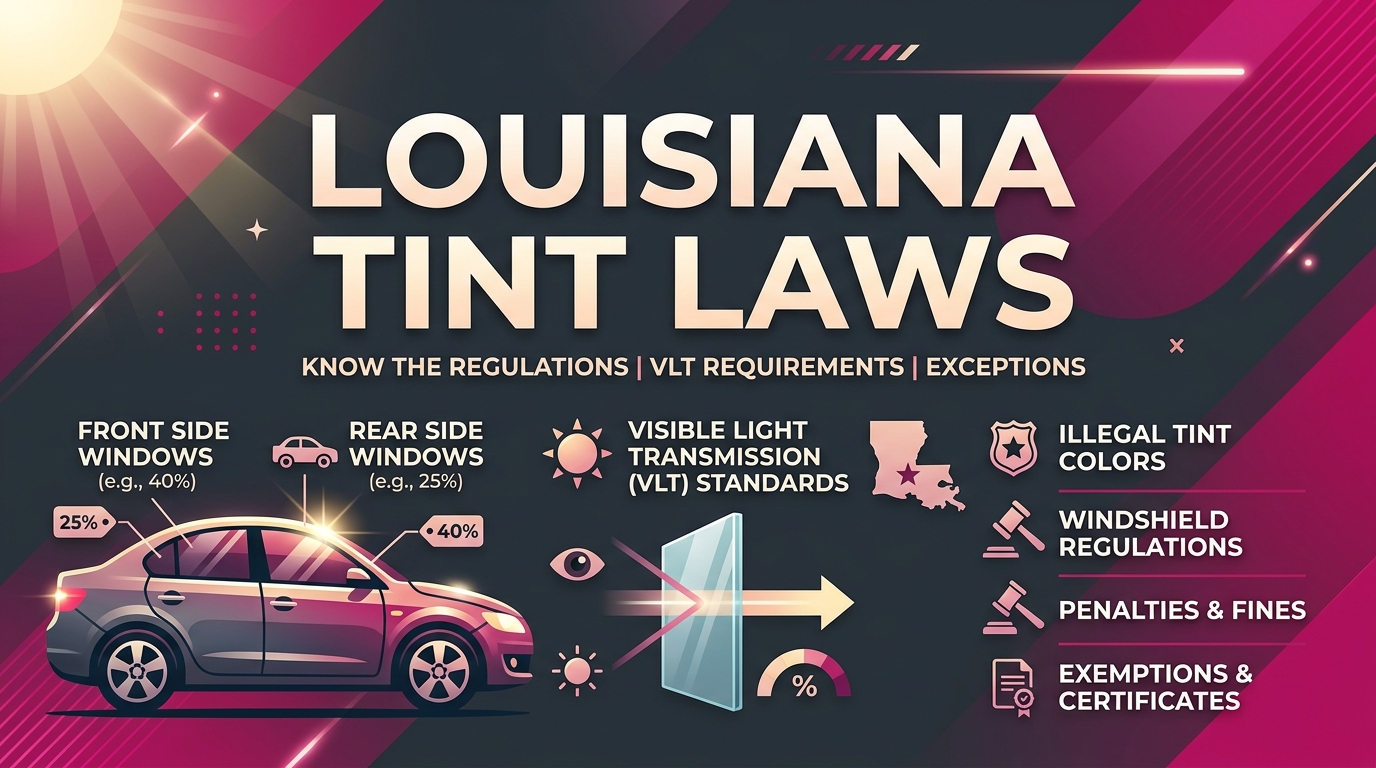
Louisiana regulates window tinting on motor vehicles primarily through Louisiana Revised Statutes (R.S.) 32:361.1, which balances driver visibility, public safety, and practical needs such as glare reduction in the state’s sunny climate. These rules apply to passenger cars, trucks, SUVs, vans, and other vehicles, with distinctions based on vehicle classification and specific exemptions.
As of 2026, a significant update took effect on August 1, 2025, via Act 143 of the 2025 Regular Session. This legislation lowered the minimum visible light transmission (VLT) requirement for front side windows from 40 percent to 25 percent for most vehicles. The change responded to concerns about sunlight sensitivity while maintaining core safety standards.
This article explains the current framework governing Louisiana tint laws, including requirements for cars and trucks, enforcement mechanisms, exemptions, penalties, and practical implications for vehicle owners. It draws from the governing statute, administrative regulations, and related legal processes.
Background and Legal Context
Louisiana’s window tint regulations trace back to legislative efforts in the late 1980s and early 1990s to address concerns over obscured visibility contributing to accidents. The core statute, R.S. 32:361.1, prohibits materials that obstruct a driver’s clear view through the front windshield or front side windows or that alter color or reduce light transmission beyond specified limits.
Key definitions in the law include:
- Light transmission (VLT): The percentage of visible light passing through the combined film and glazing.
- Luminous reflectance: The percentage of light reflected outward (capped at 20 percent).
- Sun screening device: Film or material applied to safety glazing.
The law distinguishes between passenger cars (often classified as “sedans”) and multipurpose passenger vehicles (MPVs), which include SUVs, vans, and many trucks based on federal certification labels (e.g., “MPV” or “TRUCK” on the driver’s door jamb). Windows behind the driver on these MPVs receive broader exemptions.
Prior to August 1, 2025, front side windows generally required at least 40 percent VLT. The 2025 amendment aligned Louisiana more closely with neighboring states while preserving requirements for front visibility. Older vehicles tinted before 1994 under prior rules may qualify for grandfathering with proper certification.
Enforcement occurs through routine traffic stops, vehicle safety inspections (where applicable), and use of approved tint meters by law enforcement. The Louisiana State Police and local agencies handle compliance, with the Office of Motor Vehicles (OMV) involved in exemptions and certifications.
Key Provisions of Louisiana Tint Laws Explained
Visible Light Transmission (VLT) Requirements
VLT measures how much light passes through the window (film plus glass). Lower percentages indicate darker tint. Measurements use approved meters and account for all tolerances.
For passenger cars (sedans):
- Front side windows (driver and passenger): Minimum 25% VLT.
- Side windows behind the driver: Minimum 25% VLT.
- Rearmost window: Minimum 12% VLT.
For SUVs, vans, trucks, and multipurpose passenger vehicles (MPVs):
- Front side windows: Minimum 25% VLT.
- Side windows and rearmost windows behind the driver: No VLT minimum (any darkness permitted, subject to other rules).
Windshield Rules (All Vehicles): Only non-reflective, transparent material (not red or amber) is allowed on the topmost portion, extending no more than five inches down from the top or above the manufacturer’s AS-1 line, whichever is applicable. The rest of the windshield must remain clear.
Reflectivity: All sun screening devices: Maximum 20% luminous reflectance.
Color and Other Restrictions: Tint must not alter the color of light transmission (typically smoke/gray tones only). No vehicle wraps on glass. Adjustable nontransparent sun visors are permitted if mounted forward of side windows and not attached to glass.
Labeling Requirements: Installers must affix a small label (no larger than 1.5 square inches) in the lower right corner of the driver’s side window, including the installer’s name and city. Manufacturers and installers must certify compliance.
These provisions reflect established regulatory frameworks aimed at balancing safety (clear forward vision) with consumer benefits (reduced glare, heat, and UV exposure). Courts and agencies interpret them in the context of traffic safety statutes.
Latest Developments
The primary recent development is Act 143 (2025), effective August 1, 2025, which amended R.S. 32:361.1 to permit darker front side window tint. This followed advocacy highlighting medical needs, such as photosensitivity from medications or conditions.
In 2024, Act 268 expanded exemptions for certain publicly owned law enforcement vehicles, including those of the Department of Wildlife and Fisheries.
Administrative updates to Louisiana Administrative Code (e.g., Title 55, Part III) aligned inspection standards with the new VLT limits. No major statewide litigation challenging the core framework has altered these rules as of 2026, though individual enforcement disputes may arise in local courts.
Who Is Affected and Potential Impact
Vehicle Owners and Drivers
- Car, truck, and SUV owners must ensure compliance during operation. Non-compliant tint can lead to traffic citations, failed inspections (in jurisdictions still requiring them), or removal orders.
- Individuals with medical conditions (e.g., lupus, porphyria, or severe photophobia) may qualify for exemptions allowing darker tint.
Tint Installers, Sellers, and Manufacturers: Businesses face stricter penalties for supplying or installing non-compliant products, including fines and potential business prohibitions. This encourages certified, compliant practices.
Law Enforcement and Commercial Operators: Police vehicles have broad exemptions. Commercial motor vehicles may face additional federal visibility requirements (e.g., 70% VLT for certain windows under FMCSA rules).
Potential Consequences: Illegal tint increases risks of stops, fines, and liability in accident cases where visibility is questioned. Compliant tint can improve comfort and reduce interior heat without compromising safety. Vehicle classification (checked via door jamb label) determines applicable rules, affecting truck and SUV owners differently from sedan drivers.
What This Means Going Forward
Louisiana’s louisiana tint laws continue to evolve incrementally in response to public input, medical needs, and safety data. The 2025 change demonstrates legislative responsiveness while upholding core visibility standards enforced by state police and courts.
Vehicle owners should:
- Verify tint levels with certified installers using proper meters.
- Retain documentation for exemptions or pre-1994 tinting.
- Monitor for future amendments, particularly around medical exemptions or inspection processes.
Law enforcement will likely continue using tint meters during stops, with courts applying the statute’s graduated penalty structure. Stakeholders, including bar associations and consumer groups, can track regulatory updates through the Louisiana State Legislature website and Louisiana State Police resources.
Conclusion
Louisiana’s current louisiana tint laws, codified primarily in R.S. 32:361.1 and updated in 2025, provide a structured framework that accommodates vehicle owners’ needs while prioritizing roadway safety. Understanding vehicle-specific requirements, exemptions, and compliance obligations helps drivers avoid violations and supports informed decisions about tint installation.
This article is for informational purposes only and does not constitute legal advice. Laws can be subject to interpretation and amendment. Vehicle owners should consult the Louisiana State Legislature website, Louisiana State Police, or a qualified attorney for advice specific to their situation. Staying informed through official channels ensures ongoing compliance with these regulations.
Frequently Asked Questions
What are the current VLT requirements for front side windows in Louisiana?
As of August 1, 2025, front side windows on most vehicles must allow at least 25% light transmission. This applies to both sedans and MPVs like SUVs and trucks.
Do SUVs and trucks have different tint rules than cars?
Yes. While front side windows share the 25% VLT minimum, windows behind the driver on multipurpose passenger vehicles (including many SUVs, vans, and trucks) have no VLT minimum. Sedans require 25% on rear side windows and 12% on the rear window.
Is windshield tint allowed in Louisiana?
Limited non-reflective tint is permitted on the top five inches or above the AS-1 line. It cannot be red or amber and must not obstruct the driver’s view.
What are the penalties for violating Louisiana tint laws?
Operators face fines of up to $150 for a first offense, $250 for a second, and $350 for third or subsequent offenses. Installers, sellers, and manufacturers face higher fines (starting at $1,000) and potential business bans.
How can I obtain a medical exemption for darker tint?
Submit an affidavit from a licensed physician or optometrist documenting a qualifying sun-sensitive condition (per R.S. 32:361.2). Keep the affidavit in the vehicle, and obtain a decal from the Department of Public Safety and Corrections. Exemptions undergo review and are non-transferable upon sale.
Is there a reflectivity limit?
Yes. All allowed sun screening devices must not exceed 20% luminous reflectance.
You May Also Like: Why Some Auto Injury Claims Are Denied Even When Liability Seems Clear